Castor Oil vs Coconut Oil: Which Is Better for Hair, Skin and Face?
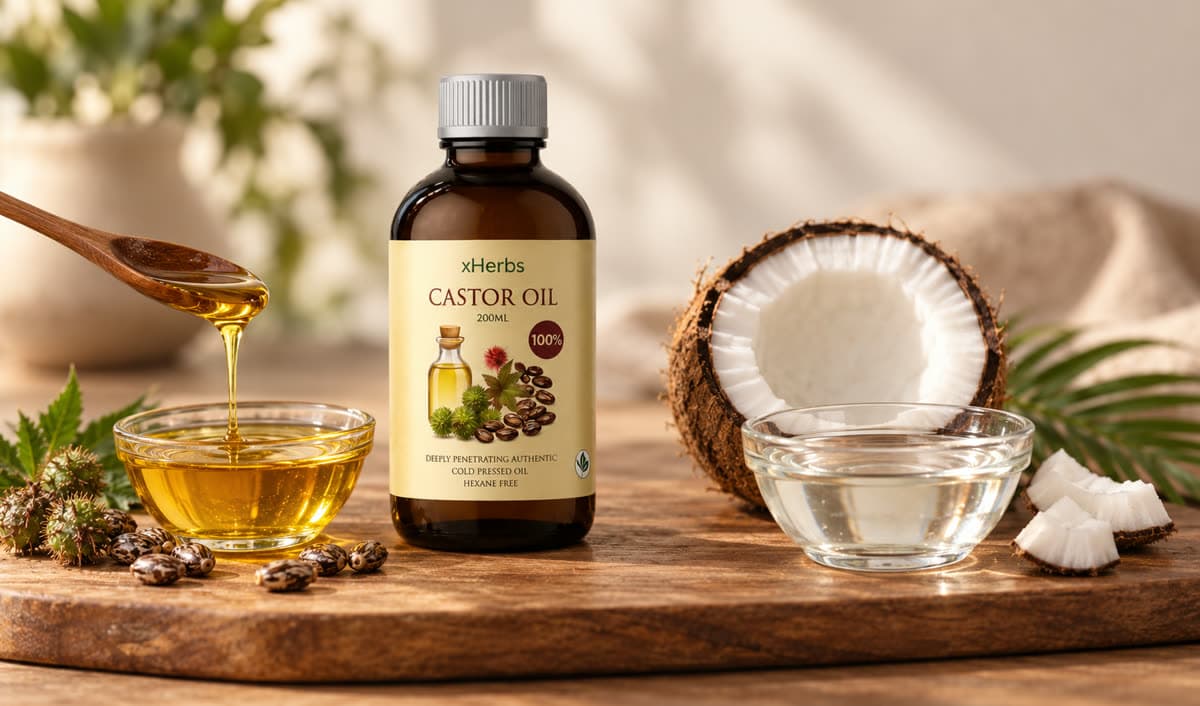
Castor oil and coconut oil do different jobs, so the right choice depends on what you are using it for. Coconut oil is light, absorbs into the hair shaft, and has the stronger evidence for hair (less protein loss when used before washing) and for dry, eczema-prone skin. Castor oil is very thick and sits on top of hair and skin, which makes it the better sealer for ends, edges, heels and cuticles. For the face, coconut oil can clog pores on acne-prone skin, while castor oil is less likely to but feels heavy. Many people get the best of both by mixing them. Here is a side-by-side for hair, skin and face, with prices and where to buy both.
Castor oil vs coconut oil at a glance
- Texture: castor oil is very thick and sticky. Coconut oil is light, and solid below about 24°C.
- Main fatty acid: castor oil is about 90% ricinoleic acid. Coconut oil is about half lauric acid.
- On hair: castor oil coats and seals the hair. Coconut oil absorbs into the hair shaft.
- Hair research: castor oil has no trials on hair growth. For coconut oil, a lab study found less protein loss when it is used before washing.
- Skin research: castor oil is a proven emollient. Coconut oil beat mineral oil in a trial on children's eczema.
- Face, acne-prone skin: castor oil is less pore-clogging but heavy. Coconut oil is more likely to clog pores.
- Smell: castor oil is mild. Virgin coconut oil smells of coconut.
- xHerbs price per ml (October 2026): castor oil is about ₦52 (200ml for ₦10,500). Coconut oil is about ₦35 (100ml for ₦3,500).
Castor oil vs coconut oil for hair
Choose coconut oil as a pre-wash treatment. Because it absorbs into the hair, it can reduce the protein hair loses during washing, which helps with breakage. It is also light enough for regular use.
Choose castor oil as a sealer on your ends and edges after moisturising, and for scalp massage when diluted. Its thickness holds moisture in, which helps in harmattan.
For hair growth: neither oil is proven to make hair grow faster. Both help you keep length by reducing dryness and breakage. Read our honest guides to castor oil for hair growth and coconut oil for hair.
Castor oil vs coconut oil for skin
- Dry body skin: coconut oil spreads easily over arms and legs. Castor oil is better for small, very dry areas like heels, elbows and cuticles.
- Eczema-prone skin: virgin coconut oil has the better evidence. In a trial in children with mild to moderate eczema, it improved symptoms more than mineral oil. See a doctor for severe or infected eczema.
- Massage: coconut oil glides easily, and castor oil gives a slower, heavier massage. Many people mix them.
Castor oil vs coconut oil for the face
- Acne-prone or oily skin: be careful with coconut oil on the face. It is known to clog pores for some people. Castor oil is less likely to, but it is heavy, so use only a drop, or mix it with a lighter oil.
- Dry skin: either can work as a final layer over moisturiser at night.
- Always patch test on your jawline for a few days before using either oil all over your face.
More detail is in castor oil for face.
Castor oil vs coconut oil for eyelashes and eyebrows
Castor oil is the traditional choice, but no good study shows that either oil grows lashes or brows. If you try one, apply a tiny amount to brows with a cotton bud and keep it out of your eyes. See castor oil for eyelashes and eyebrows.
How to use them together
Mixing is often better than choosing:
- Scalp oil: 1 part castor oil to 2 parts coconut oil. It spreads easily and washes out better than castor alone.
- Edges: a drop of castor oil with a few drops of coconut oil.
- Body: coconut oil all over, castor oil on heels and elbows.
If coconut oil is solid, warm it gently first by standing the bottle in warm water, then mix.
Where to buy castor oil and coconut oil
- Port Harcourt, both oils: Doyen Pharmacy, beside Salvation Ministry, Okuru Link, Golf Estate Road, Golf Estate. Tel: 0815 091 0417 or 0815 091 0418.
- Lagos, castor oil: Elo-Ruks Naturals, Shop E2/379, Articles Market, Abule Oshun.
- Online: xHerbs Castor Oil 200ml and xHerbs Coconut Oil 100ml.
Frequently asked questions
Which is better for hair, castor oil or coconut oil?
Coconut oil is better as a pre-wash treatment to reduce protein loss. Castor oil is better as a sealer for ends and edges. Neither is proven to speed up growth. Many people use both.
Which is better for skin?
Coconut oil for all-over dry skin and mild eczema-prone skin. Castor oil for small, very dry areas like heels, elbows and cuticles.
Can I mix castor oil and coconut oil?
Yes. One part castor oil to two parts coconut oil makes an easy-to-spread scalp and hair oil.
Which is better for the face?
For acne-prone skin, castor oil in tiny amounts is less likely to clog pores than coconut oil. Patch test either one first.
Bottom line: Use coconut oil as a light pre-wash and all-over body oil, and castor oil as a heavy sealer for ends, edges, heels and cuticles, or mix them 1 to 2. Neither grows hair faster, but both help you keep it. Buy both at Doyen Pharmacy, Port Harcourt, castor oil at Elo-Ruks Naturals, Lagos, or both on xherbs.store.